22 February 2012

GCN Biennial meeting: report on our activities

Dr Joseph Shaw
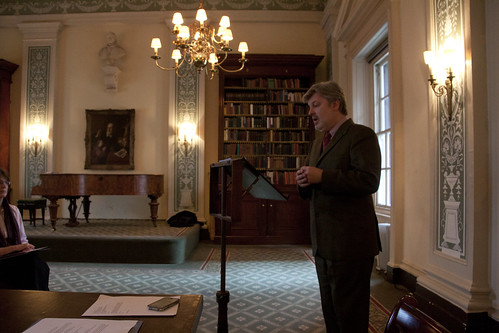
One of the things which happened at the meeting was a report by me (Joseph Shaw: photo courtesy of Henry de Villiers) on the activities of the GCN over the last couple of years. It's all been on this blog, for the most part, but here's a summary.

We have a new logo done for us - you can see it on the sidebar.

We've organised two weekend chant courses at the Oratory School; another will take place in April, led by Colin Mawby.

In collaboration with the Schola Gregoriana, there was a very successful series of chant training days in Portsmouth Cathedral, organised by our 'South' regional organiser, Neville MacMally.

Our London organiser, Matthew Schellhorn, has organised a chant day only a couple of weeks ago in Southwark Cathedral.

Training in Catholic cathedrals was one of the bright ideas we started the GCN with, and to be honest it has proved harder than I had hoped. Getting permissions together for such events requires more effort and coordination than in other venues, because more people are involved. However, we shall persevere, and I have recently met Bishop Davies of Shrewsbury who was enthusiastic about the idea for his own cathedral.

Something else I have done is the series of booklets of propers for diocesan feasts, which are now hosted on the LMS webstite, though the series is not yet complete.

Always eager to draw everyone with an interest in Chant together, I was delighted at the meeting to have representatives of the Ordinariate and the new Newman Institute, and even more pleased that they've agreed to be 'supporting organisations.'

I also drew attention to two important devopments: the establishment of the Ordinariate, and the publication of the new translation of the Missal. In both cases the forces of sanity in Church music are being given an extra opportunity. This isn't the end of the conflict, but it is certainly represents a more positive situation than before.

What we all need to continue to do, of course, is show the committment to excellence, and continual training of our singers, which alone will raise the standard of chant, attract more singers to it, and make it work as it should for the sanctification of souls.

21 February 2012

More 'supporting organisations' for the GCN

In the context of the Biennial meeting I can announce two more important organisations with a strong interest in Chant which have agreed to become 'supporters' of the Gregorian Chant Network:

Ordinariate of Our Lady
The Ordinariate of Our Lady of Walsingham


The Blessed John Henry Newman Institute of Liturgical Music in Birmingham.

Both were represented at the meeting, the Institute by Fr Guy Nichols Cong Orat, its founder and Director, and the Ordinariate by the Rev Mr Daniel Lloyd, a deacon, who was one of the assistant clergy at Vespers.


They join our founding supporters:
Fr Guy Nichols., Cong Orat


The Latin Mass Society (which sponsors the GCN financially and administratively)


Una Voce Scotland


The Schola Gregoriana of Cambridge


The Association for Latin Liturgy


St Catherine's Trust.

We also have more choirs and scholas than ever affiliated to us - they now number over 30 - and we have 6 regional coordinators, working in the North West, the North East, London, the Midlands, the South, and Wales.

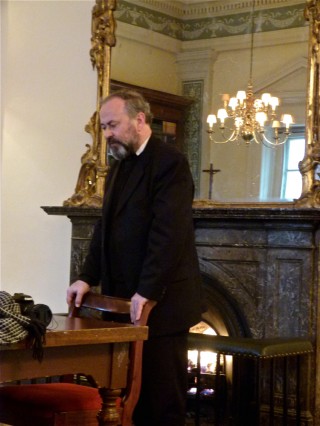
Furthermore, our meeting was attended by representatives from Una Voce France and the Irish affiliate of the Una Voce Federation, St Conleth's Catholic Heritage Association. UV France was represented by Henry de Villiers of the Schola St Cecile (and the New Liturgical Movement), and Philippe Nikolov of the Schola Reginae. The above photo of Fr Guy Nichols is from Henri's French blog post on the meeting.

Our aim is to be a forum for everyone involved in chant to be able to meet, discuss new initiatives, and give each other practical and moral support.

20 February 2012

GCN Biennial Meeting: Dr James MacMillan

I am going to do a series of posts about the meeting which took place on Saturday. In this one, I am posting the audio of James MacMillan's very interesting talk.

 IMG_8819

07 February 2012

St Edmund of Canterbury in the 1962 Calendar

St Edmund of Canterbury
St Edmund of Abingdon, or Canterbury, one of our saintly Archbishops of Canterbury, like his successor St Thomas of Canterbury spent a lot of time in exile, and indeed died there. He has two feasts in the 1962 Calendar in some dioceses. His main feast day in 16th November, but there is also a feast of his Translation (ie. the moving of his relics) on 9th June. He is particularly associated with St Edmund's College, Old Hall, Ware, where an important first-class relic is preserved and both feasts are celebrated; he is also the Patron of the Diocese of Portsmouth.

There are two different Mass formularies, with their own chants, for him. The one used by most dioceses on 16th November (ie Birmingham, Clifton, Liverpool, Leeds, Middlesbrough, Northampton, Plymouth, Salford, Shrewsbury & Southwark) is simply the Common of Confessor Bishops, Statuit ei Domini. The other, used for the Translation in the places where it is celebrated (Brentwood, Portsmouth, and Old Hall), and in Westminster, Brentwood and Portsmouth for the feast, is taken entirely from the Feast of St Edmund in the Sarum Missal. It is unusual, and possibly unique, to see a complete adoption of a Sarum Mass formulary (set of propers) in modern books. In terms of chants the pieces can all be found in the Graduale Romanum, but the Introit and Alleluia have textual variants to include his name. The alleluia is the same as St Francis of Assisi, but with 'Hic Edmundi' instead of 'Francisci'. He is also described as 'modicus', 'modest', rather than (as with St Francis) 'humilis', humble. Perhaps this is becuase, unlike St Francis, St Edmund did not manage to resist elevation to high office in the Church.

Fitting 'Hic Edmundi' into the space where 'Fransisci' is a bit of a puzzle, and we are very grateful for the help of Colin Mawby here. Mr Mawby, who was Director of Music in Westminster Cathedral in 1960s, can remember singing it in Westminster many years ago. It is good to have this kind of knowledge passed on to future generations. His help has enabled me to add this Mass to our list of Diocesan feasts on the Latin Mass Society website.

A booklet with these chants can be downloaded from the LMS website here. You can see our whole page of diocesan feasts here:

http://www.lms.org.uk/resources/gregorian-chant/proper-chants-for-the-feasts-of-england-and-wales

13 January 2012

Chant Training Day in St George's Cathedral Southwark

2011 07 02_0351
(Updated: full schedule below.)

The London coordinator of the GCN is organising a Chant Training Day for Saturday 11th February, in Cathedral: the Catholic one, St George's Cathedral, Southwark. It will be led by the Cathedral's Director of Music, Nick Gale, and will follow a chant Mass in the Cathedral in honour of Our Lady of Lourdes: it is the anniversary (and the feast) of her apparition there. It will conclude with Vespers.

Mass is at 10.30 am; the chant training will begin at 11.15. Vespers will be at 4.30pm.

Singers will be divided for part of the day between more and less experienced groups, to enable everyone to get the most out of it.

Gregorian Chant Training Day with Nick Gale and Mark Johnson
(Gregorian Chant Network)

Schedule
11:45 Course begins, registration, plenary session with Nick Gale
 13:00 Lunch (bring packed lunch)
13:45 Chant Course afternoon sessions (Nick Gale and Mark Johnson)
15:30 Break 15:45 Rehearsal for Vespers
16:30 First Vespers of Septuagesima Sunday
17:00 Ends

Fee: £15; reduced to £10 for LMS members.

To register interest for the Gregorian Chant Training Day please email 


lmssouthwarknorth AT gmail DOT com

Contact (replace AT with @ and DOT with .)

06 January 2012

A Mass for St Hildelitha and St Cuthberga

St Hildelitha and St Cuthberga are wonderful examples of the extraordinary religious women produced by the Anglo-Saxons, along with St Hilda of Whitby and St Ethelberga of Ely. St Hildelitha founded a convent at Barking, which St Cuthberga joined; St Cuthberga later founded a 'double monastery' (of monks and nuns, on the same site but with separate enclosures) at Wimbourne and led a group of nuns on St Boniface's German mission. They are celebrated together, in the 1962 Calendar, in Brentwood diocese on 3rd September. Here's a stained glasss window showing St Cuthberga.

Their Mass is 'Virgines laudent nomen Domini', a Mass for 'All Virgins' (ie not only martyrs) which in 1914 was for some reason restricted to 'Certain places': that is, it stopped being used for saints in the Universal Calendar. This means that it is not to be found in the Liber Usualis; it is still in the Graduale Romanum, however, which has a section at the back for Commons used in Masses for Certain Places, and I have assembled a booklet from the Graduale scanned by the Church Music Association of America. Here they are.

http://www.lms.org.uk/resources/gregorian-chant/chant_proper_booklets/chants_for_hildelitha_and_cuthberga

The chants are ancient, but only in Brentwood Diocese on 3rd September, if you are lucky enough to be able to attend a Sung Mass in the Extraordinary Form, are you likely to hear them in a liturgical setting, at least in England and Wales.

This concludes my series of English and Welsh feasts for the time being. All of these chants, and a couple more, are to be found on the LMS website here.

03 January 2012

Bl Richard Whiting and Bl John Beche in the 1962 Missal

Another set of Chant Propers for feasts celebrated in specific dioceses in England and Wales, to be found in the same supplement for the English Benedictine Congregation where I found the Mass of the English Martyrs, is a set for the Benedictine martyrs. Richard Whiting was the Abbot of Glastonbury; Hugh Farringdon the Abbot of Reading Abbey, John Beche the Abbot of St Werburgh Abbey, Chester. These three great men were martyred by King Henry VIII. The Benedictines celebrated their feast, and that of 'four other Benedictine monks, martyrs', on December 1st.


On the same day, various dioceses throughout England celebrated martyrs special to themselves. In Birmingham it is the Martyrs of Oxford University, in Nottingham St Ralph Sherwin, in Northhampton and Portsmouth it is St Edmund Campion and Companions. As far as chants go, these feasts all use one of the standard Masses for Martyrs, 'Intret in conspectu'. In Westminster, however, they celebrate Bl. Hugh Farringdon & Companions, and in Brentwood Bl John Beche, using the same Mass as the Benedictines: 'Vineam de Aegypto'.

I have created a booklet of these chants, and you can download them here.

http://www.lms.org.uk/resources/gregorian-chant/chant_proper_booklets/proper_chants_for_whiting_and_beche

Pictures: Blessed Hugh Farringdon on the left, and Bl John Beche on the right.

31 December 2011

St Helen, Empress, in the 1962 Missal

As I noted in an earlier post, I have seen the propers for feasts for the whole of England and Wales pasted into the back of old Libers, but I have never seen the chants for feasts specific to particular dioceses, or groups of dioceses. I was delighted to discover, then, that one of these, St Helen, Empress (18th August) is included in the supplement for the United States of America, which is included in the on-liber Liber Usualis scanned by the Church Music Association of America. I have uploaded a booklet of these chants to the LMS website; they can be downloaded as a pdf here:

http://www.lms.org.uk/resources/gregorian-chant/chant_proper_booklets/st_helen

The feast of St Helen is a 3rd Class feast in Liverpool and Salford, and St Helen is the co-titular of Brentwood Cathedral, so it is celebrated in that Cathedral as well (First Class). St Helen, the finder of the True Cross and mother of the Emperor Constantine, was, of course, said to be a British princess. Britain played an important part in her son's life, since he was proclaimed Emperor at York; he went on to vindicate his claims in the ensuing civil war, and make Christianity the official religion of the Roman Empire. Evelyn Waugh's historical novel 'Helena' is a thoroughly enjoyable re-telling of St Helen's legend.

If anyone has information about other diocesan feasts, or the chant settings of any other diocesan feasts, please let me know! I am anxious to find

Bl Adrian Fortescue (Birmingham diocese, 11th July)
Our Lady in Porticu (Cardiff and Menevia, 17th July)
Bl Hugh More (Nottingham, 1st September)
St Hilda (Westminster, Birmingham, Clifton, Northhampton, Nottingham, 17th November).

Others I have found I will publish in due course.

29 December 2011

Propers of National and Diocesan Feasts in the 1962 Missal

I have spent some time recently researching feasts proper to England and Wales in the 1962 Missal. There are feasts proper to the whole of England and Wales: nine, to be exact, including St George (April 23rd) and the Martyrs of England and Wales (May 4th). There are also, listed conveniently in the Baronius Press hand missal, pages and pages of feasts not in the Unversal Calendar of the Latin West, and not celebrated in the whole of England and Wales, but still celebrated in certain dioceses in England and Wales.

These feasts become problematic when they have special texts composed for them. The texts themselves are not difficult to find - diocesan supplements for the altar missals exist, and they are all there in the Baronius Press missal - but when the text need to be sung, one needs to have the chant setting. And these do not seem to be widely available, if at all.
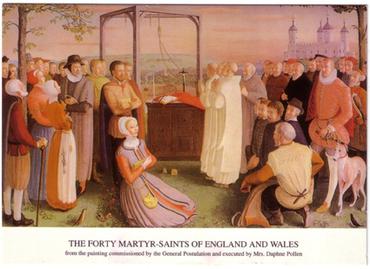
Of the feasts of the whole of England and Wales, a full 'missa propria' was composed for 'BB Joannis Fischer et Thomae Morus': that is, Bishop John Fisher and Thomas More, when they were beatified in 1886; the feast was originally celebrated on 4th May. This Mass, 'Deus venerunt gentes', stayed on 4th May when SS Fisher & More were canonised and moved to July 9th (getting a new Mass formulary), and 4th May became the feast of the Blessed Martyrs of England and Wales. I have found it in the English Benedictine supplement included in a 1908 Schwann Graduale and a later Solesmes Graduale, both of which I have been able to scan. It is a 3rd Class feast.

Here is the Introit being sung by the Schola Abelis of Oxford; there are more videos of the propers of this Mass here.


As a service to readers I have uploaded a booklet of these propers to the Latin Mass Society website, and you can download them here:

http://www.lms.org.uk/resources/gregorian-chant/chant_proper_booklets/proper_chants_for_4th_may

Bishop Fisher and Thomas More were canonised in 1935, and I have found their new Mass pasted into the back of an old Liber Usualis I own, with an Imprimatur dated 1936. Even more conveniently, it is to be found in the Graduale Romanum's appendix 'Masses for Certain Places', including the Gradual scanned by the Church Music Association of America. Here is this Mass:


http://www.lms.org.uk/resources/gregorian-chant/chant_proper_booklets/chants_for_ss_fisher_and_more

All sorts of things can be found pasted into the back of old Libers, or loose within its pages: St Joan of Arc, St Joseph the Workman, and other things obviously added to the calendar since the date of the printing of that particular Liber. Clearly these little booklets were made available when the Mass texts and melodies were published. What I have never seen, however, in an official supplement or pasted in somewhere, are the proper chants for diocesan feasts, in cases where these are not simply borrowed from other feasts and commons. I shall be posting about some of these later.

19 December 2011

Second Biennial Meeting of the Gregorian Chant Network

Nearly two years ago, on January 30th 2010, the GCN was launched at a meeting at the London Oratory, attended by representatives of about two dozen chant scholas and a number of people involved in singing or teaching the chant. We agreed at that time to have such a meeting every two years.

The launch meeting was widely reported and was addressed by Colin Mawby, the distinguished composer and former Director of Music at Westminster Cathedral.

The next meeting is now well in preparation, and will take place on Saturday, 18th February 2012, at the London Oratory (the St Wilfrid Hall and the Little Oratory). It will be addressed by James MacMillan, another Catholic composer deeply concerned about, and practically involved in, chant. The Apostolic Nuncio, Archbishop Mennini, will join us and lead Vespers in the Little Oratory.

The meeting is an internal meeting of the GCN and as such it is invitation only. The directors of all our affiliated choirs and scholas are automatically invited, as are representatives from our 'supporter' organisations: the Latin Mass Society, the Association for Latin Liturgy, the Schola Gregoriana, Una Voce Scotland, and the St Catherine's Trust. Others involved with the chant have been invited as before. Anyone with a Catholic choir or schola can naturally get an invitation by affiliating.

For those who have received invitations, don't forget to reply!

17 December 2011

Introducinng the Juventutem London Schola

IMG_7902
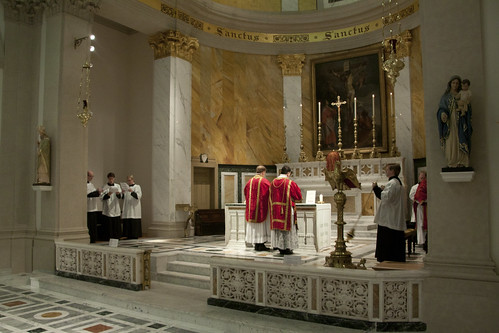
The Juventutem London Schola, in the sanctuary at St Patrick's Soho Square.
The Juventutem Movement is an international movement of young people attached to the Traditional Mass, a phenonemon observed by the Holy Father when he wrote that 'young persons too have discovered this liturgical form, felt its attraction and found in it a form of encounter with the Mystery of the Most Holy Eucharist, particularly suited to them.' The movement has groups in a number of towns and cities around England, and a particularly active one in London.

One of the features of the group is a particular love of Solemn Mass, ie Mass with celebrant, deacon and subdeacon. It should always be remembered that, although Missa Cantata and and Low Mass are indispensible elements in parish life, it is Solemn Mass which is the normative form of Mass, giving it the full honour which is its due. Solemn Mass in the Extraordinary Form is extraordinarily beautiful, with many ceremonies which are cut down, or omitted, in Missa Cantata. Obviously a choir is necessary for Solemn Mass, and after some experimentation and development (including a couple of Masses accompanied by the Schola Abelis, who had travelled from Oxford for the occasion), the London Juventutem group has now established a schola of its own, which even has a blog.

2011 10 15_1292
Polyphonists at the LMS Pilgrimage to Aylesford, with the Juventutem London Schola.

Its director is Matthew Schellhorn, a professional pianist and the Latin Mass Society Representative for Southwark North. The Juventuetem Masses are monthly, on the last Saturday of each month, and alternative months are sung with polyphony. The core of the choir is however a small chant schola, led by Matthew and drawn from the young congregation. They can also on occasion sing elsewhere, and did so at the LMS Pilgrimage to Aylesford. They have joined the GCN and have been added to the list of affiliates and the map.

2011 10 15_1351
The chant schola singing during communion at Aylesford (at the back of the photo).
Juventutem London is now established at St Mary Moorfields, 4-5 Eldon Street, EC2M 7LS, and their next Mass will be there at 6.30pm on December 23rd.

Get in touch with them by email: juventutemlondonschola@gmail.com

16 December 2011

New roving Schola for the South East: Anglorum Chorus


2011 06 22_0188
Our Lady of Willesden. The shrine image is carved out of a medieval timber from the ancient shrine, and crowned by Papal mandate. One of England's great medieval shrines, it was re-established in the 20th Century.
Christopher Hodkinson, well known as a leading member of the Schola Gregoriana of Cambridge, has founded a new schola, the Anglorum Chorus. This sings at both the Extraordinary and Ordinary Forms of the Roman Rite, and is based in the South East, though they will go anywhere where travel expenses are available.

One of their first Masses was for the Latin Mass Society Annual Pilgrimage to Willesden on 29th October. They have also sung for the Ordinariate of Our Lady of Walsingham.

The schola has joined the GCN and been added to our list of affiliates and the map. You can use this email address to contact them: anglorum.chorus@gmail.com.

10 October 2011

From the Plainsong and Medieval Music Society

News of their next conference, and a report on their last one.

PMMS Annual Conference ‘Music and Death before 1650’, Oxford, 10 March 2012

Next year’s Annual Conference will take place in Oxford at the Faculty of Music (St Aldate’s) on 10 March 2012. The event is co-organized by Elizabeth Eva Leach, Owen Rees and Catharine Bradley and will focus on the theme of ‘Music and Death before 1650’. Speakers will include, among others, Margaret Bent, Fabrice Fitch, Leofranc Holford-Strevens and Owen Rees.

Further particulars will be made available soon on the PMMS website (www.plainsong.org.uk), the PMMS Facebook group and the newsletter – so watch this space!

-------------------------------

‘From Text to Performance: medieval vernacular music in the 21st century’, Birmingham University, Barber Institute, 26 March 2011

The 2011 annual PMMS conference, organised by Mary O’Neill of the Centre for Early Music Performance & Research, as its title implies centred very much around questions of musical performance informed by scholarship; as such, it followed a workshop held at the Barber Institute on the previous day which unfortunately only a few conference participants had been able to attend.

Benjamin Bagby of Ensemble Sequentia opened the symposium with a presentation on his current project of performing the Beowulf epic, describing his attempts to reconstruct or re-imagine how this poem might have been sung. He described his experimental reconstruction of an early medieval Anglo-Saxon harp, its possible shape, range, tuning, and number of strings, based on observations of medieval mode, iconographic evidence, and deductions from the physical characteristics of wood and gut; this was complemented by observations on metre, rhyme, declamation and rhetorical aspects of the poem itself which informed the melodic shape and phrasing of his realisation. A demonstration of a section from the epic in which all these elements were brought together concluded the presentation.


Bagby’s presentation was followed by two papers on troubadours and trouvères; Peter Ricketts approached the topic from a philologist’s perspective, providing insights into his vast experience as an editor of medieval Occitan poetry and his occasional contacts with musicologists and performers attempting to come to terms with a repertoire much of which survives without musical notation. He deplored both the lack of real collaboration between textual and musical scholars in editing this repertoire and the lack of communication between philologists and performers, often leading to egregious errors in pronunciation, style, and mode of delivery. In her paper ‘From the scribe to the listener: some issues in Old French, Occitan and Galician-Portuguese song’, Mary O’Neill approached the same topic from the musical side; she pointed out even where musical notation does survive (which is the case for the Galician/Portuguese cantigas, far less so for Occitan poetry), one principal issue remains unresolved: while the pitches are straightforward to transcribe, the rhythms in non-mensural notation remain open to substantial interpretation by musicologists and modern-day performers. By giving a survey of previous and current approaches to this issue, she demonstrated how far scholarship still is from providing a robust underpinning to the practical execution of this repertoire.

After lunch, Uri Smilansky took a source-based approach to the question of performing 14th-century song in his paper entitled ‘Thinking, doing, feeling: ars subtilior and expression in medieval music’. Drawing on his own experience as a performer, he argued that there is much more to be gleaned from the page of a polyphonic music manuscript than pitches and rhythms; in particular, he demonstrated impressively how rhythmic-melodic gestures, in the way they occupy both musical space and the space on the written page, ‘translate’ the expression of the poetic text in a way which is immediately comprehensible to both performers and listeners. A counterpoint to this presentation was provided by Ian Rumbold who gave an overview over the repertoire of secular polyphony in the ‘St Emmeram’ codex (Munich, Bayerische Staatsbibliothek, Clm 14274) of c. 1440; Rumbold described the way in which German and French song, originals and contrafacta, local and international repertoire rubbed shoulders in this highly idiosyncratic collection of the German priest and scholar Hermann Pötzlinger.

The day was brought to a close by John Potter’s observations on ‘Finding a voice: a medieval singer in the 21st century’. Postulating a disjunction between musicologists who were, in his view, searching for absolute historical ‘truth’, and performers who were searching for artistic viability in the present, he charted his journey from a practitioner of ‘historically informed practice’ via his work on 19th-century singing styles to his recent and current experiments in the ‘Being Dufay’ project with the composer Ambrose Field where he had performed re-composed and re-imagined songs (and fragments of songs) by Guillaume Dufay for voice and electronics. Like the day as a whole, Potter’s presentation and the spirited discussion which followed it demonstrated how even after more than half a century of ‘HIP’ (and a discourse between scholars and performers which has been going on for much longer), much work is still to be done – some of it even fundamental – in finding truly common ground between the study of music and its performance.

Thomas Schmidt-Beste

15 September 2011

Chant Training in London

The Schola Gregoriana of Cambridge will run a course of chant evenings at the

Farm Street Church,
114 Mount Street, London W1,

at 6.30 pm each Tuesday from 27th September to 13th December, except 15th November.

Directed by Dr. Peter Wilton, B. Ed (Hons), M Mus., Editor of chant for the Office of Vespers for Westminster Cathedral Choir..

Practical instruction includes: Music of the New English Missal, Chant performance, Music for the Mass and Daily Offices, English and Latin texts.

Anyone able to sing in tune is welcome, with or without chant experience.

£5 per evening, or £50 for the term. Enquiries to: Mr. G. Macartney, Schola Gregoriana of Cambridge, 26 The Grove, Ealing, London, W5 5LH 020 8840 5832 (answerphone when out).

- Posted using BlogPress from my iPhone

02 August 2011

New Guide for Scholas for the EF

The Latin Mass Society has just added to its website a comprehensive guide to singers of when to sing what pieces of chant, and how long they have before they disrupt or delay the Mass.

It includes the two videos I posted earlier, showing the sequence of events leading up to the singing of the Sanctus and to the Agnus Dei.

The guide, while not infallible, has been pored over by a number of singers and rubricists, and it is to be hoped that it will prove useful to singers less familiar with the Extraordinary Form (the Traditional Mass) when called upon to accompany it, and even those who wish to confirm their instincts. It increasingly happens that a parish choir is asked to provide singing for a traditional Requiem or a Mass for some special occasion, and while mastering the chants is one issue exactly what they are expected to do and when is quite another!

See the Guide here.