
04 October 2013

03 October 2013
Schola Gregoriana Weekend in Whitby 22-24th November
SNEATON CASTLE CENTRE, WHITBY
Friday 22nd
November to Sunday 24th.
St.
Charlemagne and the Play of Antichrist
Sing, study
and learn about music from the early Middle Ages in honour of the first Holy
Roman Emperor and his successors, and chants for the Feast of Christ the King.
The programme
will include excerpts from the early 13th c. Office of 'St. Charlemagne'
together with hymnody from the Carolingian renaissance and some of the earliest
polyphony, and a speculative edited reconstruction of the semi-liturgical drama
'Ludus de Antichristo' from 12th c. Germany, in which the Holy Roman Emperor
Frederick I 'Barbarossa' is first seduced by Antichrist and then won back to
the true faith.
This programme
will be the basis of a concert to be performed by the Schola with the Bristol
University Schola Cantorum on Saturday 30th November, 7.30 pm, at the Temple
Church, Fleet Street, London EC4Y 7HL
The inclusive
cost of board, accommodation, music and tuition is £200.
For full
details, and non-residential participation, please address enquries toscholacambridge@aol.com,
or St. Benedict's, 124 Cambridge Road, Barton, Cambridge, CB23 7AR Tel:
01223 263063
06 September 2013
Call for singers for YCA retreat, 18-20 October
John Curran, of the Schola Gregoriana of Cambridge, seeks help to provide a small group of singers to support the Young Catholics’ Association annual retreat at the Franciscan house at Cold Ash, near Thatcham in Berkshire during the weekend 18-20 October.
Depending on your talents you might consider to serve as an ordinary robust choir member for Compline, Vespers and the Ordinary of Mass in the Extraordinary Form, or also help rehearse the Proper of the Mass. We will be trained by one of the Schola’s professional chant experts.
You can also take part all other events and spiritual conferences of the weekend.
John has arranged an inclusive £100.00 package from Friday evening (18th to lunch Sunday 20th October.)
Contacts: JPCSedate@aol.com; 01509 852259 (up to 8pm!)
Depending on your talents you might consider to serve as an ordinary robust choir member for Compline, Vespers and the Ordinary of Mass in the Extraordinary Form, or also help rehearse the Proper of the Mass. We will be trained by one of the Schola’s professional chant experts.
You can also take part all other events and spiritual conferences of the weekend.
John has arranged an inclusive £100.00 package from Friday evening (18th to lunch Sunday 20th October.)
Contacts: JPCSedate@aol.com; 01509 852259 (up to 8pm!)
22 May 2013
20 March 2013
PIMMS Conference, 10th July
PMMS 125th Anniversary
There’s no place like Rome: Centres of music and liturgy before 1550
PMMS members are warmly invited to the AGM study day on 10 July 2013, held at Bedern in the city of York. The day will celebrate the Society’s 125th anniversary with a wine reception and free evening concert of conductus by candlelight, two public lectures and a series of papers held in medieval venues in York city centre. The theme of the day is the exploration of centres of music and liturgy before 1550, and will have a good balance of talks on plainchant and polyphony. Speakers include Roger Bowers, Emma Hornby, Rebecca Maloy, Andrew Kirkman, Jim Borders, Thomas Schmidt, Matthew Ward and Hannah Vlhova.
Registration will be in the region of £50 (non-members) and £35 (members and students). Delegates will be provided with lunch, refreshments, a free ticked to an evening performance at the Merchant Venturer’s Hall and a discounted ticket to a further concert at York Minster, as part of York Early Music Festival. Further details and registration will appear on the PMMS website in the new year. The day will also include the AGM, which is free to attend.
Delegates may like to stay for a few days to enjoy further events at the York Early Music Festival (Friday 5 - Saturday 13 July) and will focus on Rome, with music created under the patronage of medieval Popes, the renaissance polyphony of Palestrina, and the exuberant baroque of Handel in Italy. Special features will include a celebration of the anniversaries of Corelli (1653-1713) and Dowland (1563-1626). Artists will include countertenor Iestyn Davies, one of the world's foremost viol players Wieland Kuijken, the Italian medieval Ensemble Medusa with singer Patricia Bovi, medievalist Stevie Wishart and her group Sinfonye and Theatre of the Ayre with Elizabeth Kenny and members of the Ukulele Orchestra of Great Britain!
You will find the registration form attached, or alternatively you can download it from the PMMS website at http://www.plainsong.org.uk/
09 March 2013
Introducing: Juventutem Bristol Schola
 A new affilate of the GCN is Juventutem Bristol Schola. As the name implies, this is part of the Juventutem Federation, and is composed of young people - Bristol, of course, is home to many students. They are financially supported by the Latin Mass Society, and since at celebrations of the Extraordinary Form in the Church of Holy Cross, Bristol.
Check out their blog here.
Floreat!
13 February 2013
Blasted blogger

Apologies to all for the inconvenience. And may the gremlins be afflicted with halitosis.
Please update your links to http://gregorianchantnetwork.blogspot.co.uk
Chant Training at Ealing Abbey
Gregorian chant workshop
Wednesdays
6.40 to 8 pm
Bulbeck Room
Ealing Abbey
Ealing Abbey Parish Schola
Director: Jennifer Smith
0777 625 7472
je.ma.smith@virginmedia.com
ALL WELCOME
No qualifications required – only to love singing and to do so in tune!
Wednesdays
6.40 to 8 pm
Bulbeck Room
Ealing Abbey
Ealing Abbey Parish Schola
Director: Jennifer Smith
0777 625 7472
je.ma.smith@virginmedia.com
ALL WELCOME
No qualifications required – only to love singing and to do so in tune!
19 January 2013
Chant training in Gloucestershire
From an email.
We are holding a day-long Plainchant workshop on
Saturday 16th February 2013
from 10 am to 4.30 pm at the Marist Convent, Nympsfield.
The workshop will be led by former Westminster Cathedral Head Chorister Rupert Bevan. It is aimed at those with some musical knowledge/ability.
There is no charge for tuition: the purpose of the workshop is to form a small Schola to sing at Mass once a month on a Sunday evening at St Dominic’s, Dursley.
To find out more, please contact
Sara Harvey-Craig on tel: 01453 872925
or email: saraharveycraig@hotmail.com
14 January 2013
Announcing the Chant Training Weekend 2013

The Gregorian Chant Network's annual big chant course - a three-day intensive course (Friday afternoon/evening to Sunday morning) - will take place 5th to 7th April 2013. That is, Easter Friday to Low Sunday, the weekend after Easter itself, at the Oratory School, near Reading (map).
It will be led by Christopher Hodkinson, one of the Musical Directors of the Schola Gregoriana of Cambridge.
Each of them has an enormous experience of chant, its interpretation and performace, and having two chant teachers will enable participants to be divided for various purposes in the course of the weekend, enabling everyone to be taught in a way appropriate to their experience.

The course has always run alongside the St Catherine's Trust Family Retreat. Apart from seeing the vast number of small children devoted to the Church ancient liturgy, which is always fun, this means that participants in the chant course have the opportunity to sing at a succession of live liturgical events with an appreciative audience. Each of the three days has a Traditional Sung Mass, which have a special interest because it will be the week after Easter. There is also Compline on two days, and Vespers and Benediction on the Saturday. The Retreat this year will be led by Fr John Hunwicke of the Ordinariate of Our Lady of Walsingham.
The headline price is £90 all inclusive (tuition, accomodation and meals), and this falls dramatically for groups of singers from the same schola, if the schola is affiliated to the GCN. (And yes, of course you can affiliate right away at no cost, if you want to take advantage of this offer!). There is also a discount for LMS members, thanks to sponsorship from the Latin Mass Society. This means that it can be as cheap at £30 a person!
£90 per person
£50 each for 2 people from the same choir or schola
£40 each for 3 or more people from the same choir or schola
£10 discount for LMS members
The GCN's hope is that the course will be taken by enough members of a given group to make a difference to performance when they get home, and not just by an individual here and there. It is up to Chant Directors to make this happen!

Download an application form:
For Choir directors signing up several people;
For individuals, and for the Retreat.
Or email us: info@stcatherinestrust.org
05 January 2013
Medieval Music Conference, September 2013
Cantum Pulcriorem Invenire: Music in Western Europe, 1150-1350, Southampton, 9-10 September 2013
Following the first conference on the music of the Ars Antiqua in Princeton in November 2011, the University of Southampton’s Department of Music will host the second conference in this series at its Highfield Campus on 9-10 September 2013.
The conference seeks to shed light on the issues around the discovery and management of known and newly-discovered source material, the implications of claims of meaning in thirteenth-century music, the use of digital technologies in the study of music of the period, as well as other traditional and innovatory approaches.
The conference invites papers on any aspect of music of Western Europe between 1150 and 1350. If applicable, authors of papers will be able to benefit from the presence of the artists on the recent CD: John Potter, Christopher O’Gorman, Rogers Covey-Crump, ‘Conductus 1: Music and Poetry of Thirteenth-Century France’. Hyperion, CDA67949, 2012. Visit the websitefor more information.
Proposals for papers should make explicit their aims, methods and outcomes, and should not exceed 300 words; they should also explain how the paper would benefit from the participation of the artists given above. Proposals for linked papers or complete sessions are also welcome. Abstracts should be sent in duplicate: one version should be anonymous; the other should include name and full contact details.
The conference will provide accommodation for the nights of 8, 9, 10 September 2013, all meals, and aims to reimburse travel from both within the UK and abroad.
The conference director, Mark Everist, will be happy to discuss proposals in advance of formal submission (m.everist@southampton.ac.uk). Closing date for submission of proposals for papers is Friday 25 January 2013. Proposals should be sent as email attachments in pdf format to:G.Bevilacqua@soton.ac.uk and this call for papers, together with material relating to the conference will be posted in the ‘Cantum pulcriorem invenire’ website.
Following the first conference on the music of the Ars Antiqua in Princeton in November 2011, the University of Southampton’s Department of Music will host the second conference in this series at its Highfield Campus on 9-10 September 2013.
The conference seeks to shed light on the issues around the discovery and management of known and newly-discovered source material, the implications of claims of meaning in thirteenth-century music, the use of digital technologies in the study of music of the period, as well as other traditional and innovatory approaches.
The conference invites papers on any aspect of music of Western Europe between 1150 and 1350. If applicable, authors of papers will be able to benefit from the presence of the artists on the recent CD: John Potter, Christopher O’Gorman, Rogers Covey-Crump, ‘Conductus 1: Music and Poetry of Thirteenth-Century France’. Hyperion, CDA67949, 2012. Visit the websitefor more information.
Proposals for papers should make explicit their aims, methods and outcomes, and should not exceed 300 words; they should also explain how the paper would benefit from the participation of the artists given above. Proposals for linked papers or complete sessions are also welcome. Abstracts should be sent in duplicate: one version should be anonymous; the other should include name and full contact details.
The conference will provide accommodation for the nights of 8, 9, 10 September 2013, all meals, and aims to reimburse travel from both within the UK and abroad.
The conference director, Mark Everist, will be happy to discuss proposals in advance of formal submission (m.everist@southampton.ac.uk). Closing date for submission of proposals for papers is Friday 25 January 2013. Proposals should be sent as email attachments in pdf format to:G.Bevilacqua@soton.ac.uk and this call for papers, together with material relating to the conference will be posted in the ‘Cantum pulcriorem invenire’ website.
20 December 2012
PIMS AGM and Conference in York
PMMS 125th Anniversary, York, 10 July 2013
There’s no place like Rome: Centres of music and liturgy before 1550
PMMS members are warmly invited to the AGM study day on 10 July 2013, held at Bedern in the city of York. The day will celebrate the Society’s 125th anniversary with a wine reception and free evening concert of conductus by candlelight, two public lectures and a series of papers held in medieval venues in York city centre. The theme of the day is the exploration of centres of music and liturgy before 1550, and will have a good balance of talks on plainchant and polyphony. Speakers include Roger Bowers, Emma Hornby, Rebecca Maloy, Andrew Kirkman, Jim Borders, Thomas Schmidt, Matthew Ward and Hannah Vlhova.
Registration will be in the region of £50 (non-members) and £35 (members and students). Delegates will be provided with lunch, refreshments and a discounted ticket to a further concert at York Minster, as part of York Early Music Festival. Further details and registration will appear on the PMMS website in the new year. The day will also include the AGM, which is free to attend.
Delegates may like to stay for a few days to enjoy further events at the York Early Music Festival (Friday 5 - Saturday 13 July) and will focus on Rome, with music created under the patronage of medieval Popes, the renaissance polyphony of Palestrina, and the exuberant baroque of Handel in Italy. Special features will include a celebration of the anniversaries of Corelli (1653-1713) and Dowland (1563-1626). Artists will include countertenor Iestyn Davies, one of the world's foremost viol players Wieland Kuijken, the Italian medieval Ensemble Medusa with singer Patricia Bovi, medievalist Stevie Wishart and her group Sinfonye and Theatre of the Ayre with Elizabeth Kenny and members of the Ukulele Orchestra of Great Britain!
There’s no place like Rome: Centres of music and liturgy before 1550
PMMS members are warmly invited to the AGM study day on 10 July 2013, held at Bedern in the city of York. The day will celebrate the Society’s 125th anniversary with a wine reception and free evening concert of conductus by candlelight, two public lectures and a series of papers held in medieval venues in York city centre. The theme of the day is the exploration of centres of music and liturgy before 1550, and will have a good balance of talks on plainchant and polyphony. Speakers include Roger Bowers, Emma Hornby, Rebecca Maloy, Andrew Kirkman, Jim Borders, Thomas Schmidt, Matthew Ward and Hannah Vlhova.
Registration will be in the region of £50 (non-members) and £35 (members and students). Delegates will be provided with lunch, refreshments and a discounted ticket to a further concert at York Minster, as part of York Early Music Festival. Further details and registration will appear on the PMMS website in the new year. The day will also include the AGM, which is free to attend.
Delegates may like to stay for a few days to enjoy further events at the York Early Music Festival (Friday 5 - Saturday 13 July) and will focus on Rome, with music created under the patronage of medieval Popes, the renaissance polyphony of Palestrina, and the exuberant baroque of Handel in Italy. Special features will include a celebration of the anniversaries of Corelli (1653-1713) and Dowland (1563-1626). Artists will include countertenor Iestyn Davies, one of the world's foremost viol players Wieland Kuijken, the Italian medieval Ensemble Medusa with singer Patricia Bovi, medievalist Stevie Wishart and her group Sinfonye and Theatre of the Ayre with Elizabeth Kenny and members of the Ukulele Orchestra of Great Britain!
18 December 2012
Messiaen, birdsong, and chant
The pianist Matthew Schellhorn, who is also very much involved in the Gregorian Chant Network, has given an interview on Messiaen, on whom he is an expert, and birdsong. Messiaen was fascinated by birdsong, and based numerous compositions on it. Matthew remarks:


While Messiaen found birds to be "sovereign" in their creative capacity, he also said they are "the closest to us, and the easiest to reproduce". I should assert that the only man-made music ever, perhaps, to come close to birdsong is Gregorian chant. This music, the music proper to the liturgy of the Roman Catholic Church, manifests the same flexibility of both melody and rhythm. There is even evidence to suggest that the Gregorian melodies we have written down were the basis, in fact, of improvisation – which of course further reminds us of the sounds of the natural world.
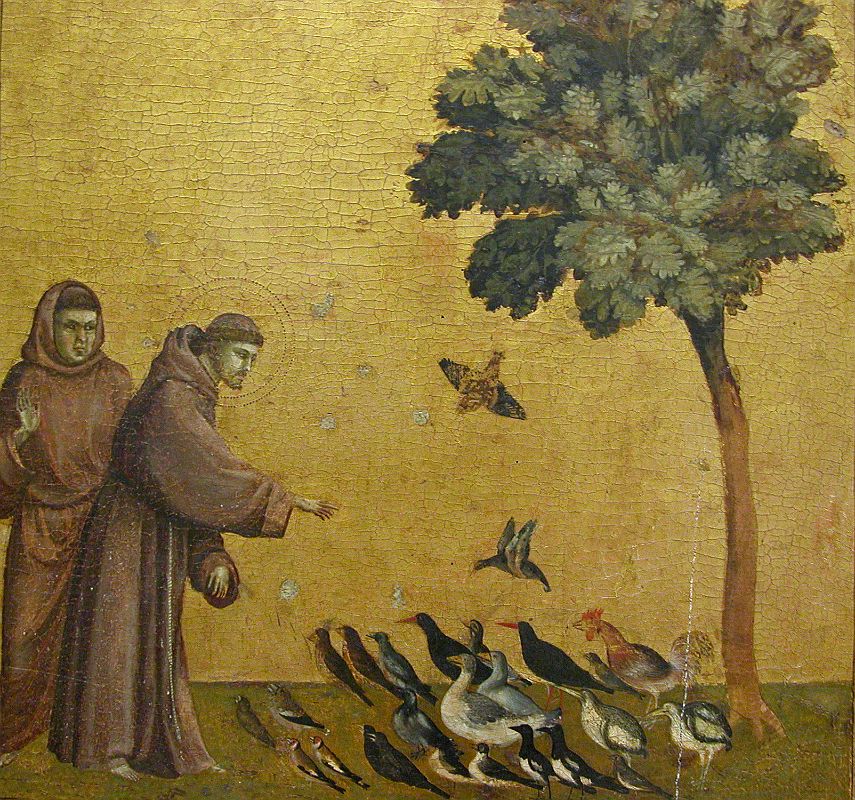
In antiquity and the Middle Ages birdsong was regarded a very significant. The above picture, from a Bestiary, shows a lion bowing to a cockerel; in Hamlet the theory that cockerels sing all night at Christmas time, banishing evil influences, as they do throughout the year at dawn, is recounted. St Francis preached to the birds, encouraging them to praise God for the natural gifts with which God had endowed them, by singing. And so, of course, they did.
It is interesting to compare the ordered spontaneity of birdsong and of Gregorian Chant. Singing Gregorian Chant has to be learnt, by human singers, but in learning to do it we reconnect with something very fundamental in human nature.
07 December 2012
Listening to sacred music IS active participation
From the Holy Father's recent address to the Italian St Cecelia Assocation.
 'The second aspect that I propose for your reflection is the relationship between sacred song and the new evangelization. The conciliar constitution on the liturgy recalls the importance of sacred music in the mission “ad gentes” and calls for an appreciation of the musical traditions of different peoples (cf. 119). But also precisely in countries, such as Italy, where evangelization occurred centuries ago, sacred music – with its own great tradition, which is our western culture – can and does have a relevant task of assisting in the rediscovery of God, a return to the Christian message and the mysteries of the faith. We think of the celebrated experience of Paul Claudel, the French poet, who converted listening signing of the Magnificat during the Christmas vespers at the Cathedral of Notre Dame in Paris: “At that moment,” he writes, “there occurred the event that dominated my entire life. In twinkling my heart was touched and I believed. I believed with such a powerful adherence, with such an elevation of my whole being, with such a strong conviction, in a certainty that did not leave space for any sort of doubt that, after that moment, no reasoning, no circumstance of my troubled life, was able to shake or touch my faith.”
 But we need not have recourse to illustrious persons to think of how many people have been touched in their depths of their soul listening to sacred music; and of how many more have felt themselves newly drawn to God by the beauty of liturgical music like Claudel. And, here dear friends, you have an important role: work to improve the quality of liturgical song with being afraid to recover and value the great musical tradition of the Church, which has in Gregorian Chant and polyphony 2 of its highest expressions, as Vatican II itself states (cf. “Sacrosanctum Concilium,” 116). And I would like to stress that the active participation of the whole people of God in the liturgy does not consist only in speaking, but in listening, in welcoming the Word with the senses and the spirit, and this holds also for sacred music. You, who have the gift of song can make the heart of many people sing in liturgical celebrations.'
 'The second aspect that I propose for your reflection is the relationship between sacred song and the new evangelization. The conciliar constitution on the liturgy recalls the importance of sacred music in the mission “ad gentes” and calls for an appreciation of the musical traditions of different peoples (cf. 119). But also precisely in countries, such as Italy, where evangelization occurred centuries ago, sacred music – with its own great tradition, which is our western culture – can and does have a relevant task of assisting in the rediscovery of God, a return to the Christian message and the mysteries of the faith. We think of the celebrated experience of Paul Claudel, the French poet, who converted listening signing of the Magnificat during the Christmas vespers at the Cathedral of Notre Dame in Paris: “At that moment,” he writes, “there occurred the event that dominated my entire life. In twinkling my heart was touched and I believed. I believed with such a powerful adherence, with such an elevation of my whole being, with such a strong conviction, in a certainty that did not leave space for any sort of doubt that, after that moment, no reasoning, no circumstance of my troubled life, was able to shake or touch my faith.”
 But we need not have recourse to illustrious persons to think of how many people have been touched in their depths of their soul listening to sacred music; and of how many more have felt themselves newly drawn to God by the beauty of liturgical music like Claudel. And, here dear friends, you have an important role: work to improve the quality of liturgical song with being afraid to recover and value the great musical tradition of the Church, which has in Gregorian Chant and polyphony 2 of its highest expressions, as Vatican II itself states (cf. “Sacrosanctum Concilium,” 116). And I would like to stress that the active participation of the whole people of God in the liturgy does not consist only in speaking, but in listening, in welcoming the Word with the senses and the spirit, and this holds also for sacred music. You, who have the gift of song can make the heart of many people sing in liturgical celebrations.'
Contrast this with the following, from an Instruction of the Congregation of Divine Worship in 1987:
'Any performance of sacred music which
takes place during a celebration, should be fully in harmony with that
celebration. This often means that musical compositions which date from
a period when the active participation of the faithful was not
emphasized as the source of the authentic Christian spirit are no
longer to be considered suitable for inclusion within liturgical
celebrations.' (Concerts in Churches, 1987).
The clear implication of the latter document is that Chant and Sacred Polyphony did not promote 'active participation'. It's not often I'd say this about an official document of the Church, even one with the limited authority of an 'Instruction' from a congregation, but this is WRONG, WRONG, WRONG.
Viva Papa!
25 November 2012
Academy of Sacred Music founded in Glasgow
A LEADING Scots lay Catholic has claimed the music sung in churches is 'lousy' and is the reason why young people have stopped going to Mass.
Joan Dillon, a Masters graduate of RSAMD (now the Royal Conservatoire of Scotland), also claimed music at Mass was 'more rooted in pop music than in sacred traditions' and was often 'so bad it distracted people from the true purpose of worship'.
She said 25 pupils from state schools currently learning Latin through the study of sacred music were the future lifeblood of the Catholic Church in Scotland.
Speaking prior to the launch of Scotland's first Academy of Sacred Music (AOSM) in Glasgow, Ms Dillon, its founder, told The Herald: 'There has been some pretty lousy music sung in Catholic churches and that is where things have gone wrong, why congregations are shrinking.
'It need not be so. As a parent myself it seems to me young people are being brought up immersed in the negative messages of modern music via MTV, a lot of which is demeaning.
'They need the transformative power of sacred music to balance that, but instead they are getting banal, happy-clappy stuff at Mass. Sacred music can lift young people up and help them embrace more noble ideas, yet it is not sung in many Catholic churches in Scotland.'
Ms Dillon said the poor standard of church music stemmed from Vatican II, the Second Vatican Council convened in 1962 by Pope John XXIII which led to Mass being said in English rather than Latin. Her support for sacred music echoes that of leading Scots composer James MacMillan, who Ms Dillon has invited to be patron of the new academy.
Mr MacMillan was commissioned to write new sacred music for masses in Glasgow and Birmingham during Pope Benedict XVI's visit to Britian in 2010 and caused controversy within the Catholic church when he claimed, in a letter to The Herald, the trend for 'touchy-feely-smiley-dancey folk' worship had 'repulsed' young people and 'put them off going to church in their droves'.
In his address tonight at St Andrew's Cathedral, Glasgow, Mr MacMillan will repeat Pope Benedict's message that 'the world needs beauty in order not to sink into despair' and that music is the most spiritual of the arts.
Asked by The Herald if he hoped the AOSM would improve the standard of sung music at Mass, Mr MacMillan said: 'I have no doubt the initiative will have a practical impact. The AOSM is a wonderful development in liturgical music in Glasgow.'
The AOSM, which is open to all religions and none, is based at Renfield St Stephen's Centre in Bath Street and runs choral classes for young people from the age of five to 18. It already has 25 students from state schools, including Glasgow's Holyrood Secondary and Uddingston Grammar.
Holyrood pupil Rosie Lavery, 14, said she would like her own church in King's Park to start a choir so she and her friends could influence what was sung. She added: 'At the moment the music is sung by the congregation and it's pretty dull.'
- Posted using BlogPress from my iPhone
Joan Dillon, a Masters graduate of RSAMD (now the Royal Conservatoire of Scotland), also claimed music at Mass was 'more rooted in pop music than in sacred traditions' and was often 'so bad it distracted people from the true purpose of worship'.
She said 25 pupils from state schools currently learning Latin through the study of sacred music were the future lifeblood of the Catholic Church in Scotland.
Speaking prior to the launch of Scotland's first Academy of Sacred Music (AOSM) in Glasgow, Ms Dillon, its founder, told The Herald: 'There has been some pretty lousy music sung in Catholic churches and that is where things have gone wrong, why congregations are shrinking.
'It need not be so. As a parent myself it seems to me young people are being brought up immersed in the negative messages of modern music via MTV, a lot of which is demeaning.
'They need the transformative power of sacred music to balance that, but instead they are getting banal, happy-clappy stuff at Mass. Sacred music can lift young people up and help them embrace more noble ideas, yet it is not sung in many Catholic churches in Scotland.'
Ms Dillon said the poor standard of church music stemmed from Vatican II, the Second Vatican Council convened in 1962 by Pope John XXIII which led to Mass being said in English rather than Latin. Her support for sacred music echoes that of leading Scots composer James MacMillan, who Ms Dillon has invited to be patron of the new academy.
Mr MacMillan was commissioned to write new sacred music for masses in Glasgow and Birmingham during Pope Benedict XVI's visit to Britian in 2010 and caused controversy within the Catholic church when he claimed, in a letter to The Herald, the trend for 'touchy-feely-smiley-dancey folk' worship had 'repulsed' young people and 'put them off going to church in their droves'.
In his address tonight at St Andrew's Cathedral, Glasgow, Mr MacMillan will repeat Pope Benedict's message that 'the world needs beauty in order not to sink into despair' and that music is the most spiritual of the arts.
Asked by The Herald if he hoped the AOSM would improve the standard of sung music at Mass, Mr MacMillan said: 'I have no doubt the initiative will have a practical impact. The AOSM is a wonderful development in liturgical music in Glasgow.'
The AOSM, which is open to all religions and none, is based at Renfield St Stephen's Centre in Bath Street and runs choral classes for young people from the age of five to 18. It already has 25 students from state schools, including Glasgow's Holyrood Secondary and Uddingston Grammar.
Holyrood pupil Rosie Lavery, 14, said she would like her own church in King's Park to start a choir so she and her friends could influence what was sung. She added: 'At the moment the music is sung by the congregation and it's pretty dull.'
- Posted using BlogPress from my iPhone
Subscribe to:
Posts (Atom)


