13 August 2012

Has Chant ever been the 'norm' at Mass in recent centuries?

Paul Inwood has initiated an interesting discussion at Pray Tell about the repeated calls by the Magisterium of the Church for Chant to be 'restored' to a place of primacy in Church music, especially at Mass. These calls, he says, indicate that it has been a very long time since chant was the 'norm' at Mass.

He gathers a useful set of quotations from official documents, but reads them in an odd way. The more they say that Chant should be given pride of place, the more he thinks that Chant does not have pride of place, because if it it did they would not need to insist on it so much. One confusion here is that, as Ben Whitworth of the Orkney Schola points out in the comments, he fails to distinguish what is NORMATIVE from what is NORMAL. Chant is the norm, and has been the norm; that is not a statistical claim but a rule and a value-judgement. Tra la sollicitudini and Guéranger, when they called for the restoration of chant, were re-articulating a norm of Catholic worship which had forgotten by all too many.

There are many such norms today...

But another confusion in Inwood's post is his identification of 'chant' with the authentic chant melodies of the Graduale Romanum. He points out that the Ratisbon ('Pustet') Gradule in use until the Graduale Romanum of 1907, and Pustet's predecessors going back to the Rennaisance, were simplified (or 'bastardised', as he calls them). We can't blame people for not using an edition which had not yet been printed, however: before 1907 there was no 1907 edition, well, obviously! And for all its deficiencies, the Pustet edition was (a) recognisably Chant, and (b) widely used. So Inwood's claim that chant settings were not widely used before the Solemnes restoration simply falls on its face.

Similarly, he dismisses the simplified versions of the chant settings used later. He doesn't name it, but the 'Rossini' propers are the obvious example of this in the English-speaking world; they set all the propers of the year to psalm-tones. Their use to the exclusion of the authentic (or indeed simplified) Gregorian melodies is of course very regrettable. But it is still chant.

Chant was normative at the eve of the Second Vatican Council in a very practical way: in accordance with the magisterial documents, it was being taught in Catholic schools, and the places where the liturgy was being celebrated with full splendour, such as monasteries and cathedrals, chant was being sung with the best available editions and to a high standard. In other places this may not have been possible, any more than the normative form of the Mass - Missa Solemnis, with priest, deacon, and subdeacon - could not always be celebrated in small parishes. But even today, when chant has almost disappeared from Catholic liturgical life, outside of the Traditional Mass, it is still normative for Catholic liturgy, for theological and aesthetic reasons, and this normative role is respected by those musicians and composers who try to use chant in the liturgy and who use chant as an inspiration. And it is being flouted by those who do the opposite.

01 August 2012

Newman Institute Conference, Sept 21-22


JHNILM Conference September 21st /22nd 2012
at the Oratory, Birmingham


In September, the Blessed John Henry Newman Institute of Liturgical Music celebrates its first birthday, and the second anniversary of the visit to the Oratory by Pope Benedict on the occasion of the beatification of Blessed Cardinal Newman, founder of the Oratory and Patron of the Institute.

To mark the occasion the JHNILM is holding a two day conference at the Oratory, on Friday 21st and Saturday 22nd September.

Speakers include Mgr Andrew Wadsworth, currently the Executive Director of ICEL, who has had varied experience as a professional musician, schoolteacher and chaplain, and who will explore the way “Towards a new Culture of Liturgical Music”.

Mgr. Andrew Burnham, is also a distinguished musician, author and former Anglican Bishop of Ebbsfleet, will speak about the musical life and aims of the Ordinariate of Our Lady of Walsingham, of which he is a member.

The outstanding organist and choral conductor Joseph Cullen, former Organ Scholar of Trinity College, Cambridge, who has held posts in Leeds, Glasgow and Westminster Cathedrals and has directed the London Symphony Chorus and Huddersfield Choral Society for many years, is addressing the Conference on the subject of “Stripping the Cladding”, in which he examines the search for an authentic voice in today's Roman Rite.

Ben Whitworth, assistant editor of the liturgical journal “Usus Antiquior” will talk on the “Use and abuse of Hymns”, exploring their true historical place in the Liturgy and ways in which they have sometimes come to be misused.

Jeremy de Satgé, founder of “The Music Makers”, singer, composer and choir conductor, will speak on “How to get Catholics to sing, or why we should sing the Mass”.

Jeremy White, the internationally renowned operatic soloist and a Cantor of the Schola Gregoriana of Cambridge, founded by the acclaimed plainchant Scholar, Dr. Mary Berry, will speak about his own experience as a church musician.

There will also be classes in practical liturgical musicianship presented by the speakers. Joseph Cullen and Jeremy de Satgé will take classes of children and introduce them to liturgical music and the art of singing it. Joseph Cullen will give direction to those who wish to learn more about the art of liturgical organ playing, particularly the accompaniment of plainchant.

First Vespers of the 25th Sunday of the Year will be sung in Latin and English Chant and directed by Philip Duffy KSG, who was for thirty years Director of Music at Liverpool Metropolitan Cathedral of Christ the King, and who now lectures in music at Liverpool Hope University.

The Conference ends with a performance of Catholic liturgical Music in the Oratory Church by the Sixteen under the direction of Harry Christophers CBE.

Attendance at the Conference and concert costs £65 and can be booked by telephone on 0121 454 0808, or by writing to JHNILM, c/o The Oratory, 141 Hagley Road, Birmingham B16 8UE, or online at admin@oratorymusic.org.uk. You can visit the Institute's website at: www.oratorymusic.org.uk

23 May 2012

Fulvio Rampi on the place of Gregorian Chant in the Liturgy

I thought this article in Chisa (an Italian newspaper) was very interesting, in its report on a recent 'Study Day' on Sacred Music in Lecce, Italy, attended by some very eminent people, notably Cardinal Walter Brandmüller, president emeritus of the pontifical committee for historical sciences, and Monsignor Valentin Miserachs Grau, President of the Pontifical Institute of Sacred Music. The article summarizes under five headings the talk of the Maestro of a chant choir which is to perform before the Holy Father, Fulvio Rampi.

Rampi defined Chant with five traits, in his talk in Lecce:


1. Gregorian is the chant "proper" to the Latin liturgy. In it, the Church speaks its thought on the Word of God in song.


2. Gregorian is the "sonorous" expression of the interpretation that the Church makes of the Word.


3. Gregorian is not ornamentation, but is itself liturgy.


4. Gregorian is liturgy in its proper times and forms: from the introit to the gradual to the "communio," from the Kyrie to the Agnus Dei.


5. Gregorian is a whole that marks out and embraces the entire liturgical year, intelligible only in its unified vision, like the Sacred Scriptures. It is the musical form of the "lectio divina" of the Church.

Full article here.

17 April 2012

Report on Weekend Chant course

IMG_9616
The Chant course was a great success this year. Nearly thiry singers took part, and were coached by Colin Mawby and Christopher Hodkinson (below).
The first Mass, on Friday evening, was accompanied by the Schola Abelis of Oxford; the remaining liturgies of the weekend were prepared for during the chant course.
IMG_9709
Chris Hodkinson got the more experienced group to do some wonderful faux bordon on Sunday with the Alleluia.
IMG_9688
Colin Mawby (above), with the less experienced group.
  IMG_9768
Singers receiving Communion before singing the Communion antiphon.
  IMG_9628
Chris Hodkinson gave a fascinating presentation on semiology to the whole group.
  IMG_0026
The singers at the final Mass on Sunday.

The combination of the Chant Course with a large retreat with the Traditioinal liturgy is a winning formula. Not only is there plenty of things to sing, but the inclusion of Vespers and Compline as well as Mass means there is a good range of difficulty in what is sung, including a significant amount of Psalmody, which is the basis of all Gregorian Chant. The presence of an appreciative congregation, and a large number of children, makes the whole thing more gratifying, and really more real, than it would otherwise be.

See here for a report on the Retreat; here for more photos.

03 April 2012

GCN Weekend Chant Course

Update: I'm putting this back at the top because this is the

LAST CALL FOR BOOKINGS!! 

 2011 04 10_8809
The Gregorian Chant Network's annual big chant course - a three-day intensive course (Friday afternoon/evening to Sunday morning) - will take place 13th to 15th April 2012. That is, Easter Friday to Low Sunday, the weekend after Easter itself, at the Oratory School, near Reading (map).

It will be led by Colin Mawby, the composer and former Director of Music at Westminster Cathedral, and Christopher Hodkinson, one of the Musical Directors of the Schola Gregoriana of Cambridge. 

Each of them has an enormous experience of chant, its interpretation and performace, and having two chant teachers will enable participants to be divided for various purposes in the course of the weekend, enabling everyone to be taught in a way appropriate to their experience.

The course has always run alongside the St Catherine's Trust Family Retreat. Apart from seeing the vast number of small children devoted to the Church ancient liturgy, which is always fun, this means that participants in the chant course have the opportunity to sing at a succession of live liturgical events with an appreciative audience. Each of the three days has a Traditional Sung Mass, which have a special interest because it will be the week after Easter. There is also Compline on two days, and Vespers and Benediction on the Saturday.

The headline price is £90 all inclusive (tuition, accomodation and meals), and this falls dramatically for groups of singers from the same schola, if the schola is affiliated to the GCN. (And yes, of course you can affiliate right away at no cost, if you want to take advantage of this offer!). There is also a discount for LMS members, thanks to sponsorship from the Latin Mass Society. This means that it can be as cheap at £30 a person!

£90 per person
£50 each for 2 people from the same choir or schola
£40 each for 3 or more people from the same choir or schola
£10 discount for LMS members

The GCN's hope is that the course will be taken by enough members of a given group to make a difference to performance when they get home, and not just by an individual here and there. It is up to Chant Directors to make this happen!

Download an application form or email us: info@stcatherinestrust.org


22 February 2012

GCN Biennial meeting: report on our activities

Dr Joseph Shaw
One of the things which happened at the meeting was a report by me (Joseph Shaw: photo courtesy of Henry de Villiers) on the activities of the GCN over the last couple of years. It's all been on this blog, for the most part, but here's a summary.

We have a new logo done for us - you can see it on the sidebar.

We've organised two weekend chant courses at the Oratory School; another will take place in April, led by Colin Mawby.

In collaboration with the Schola Gregoriana, there was a very successful series of chant training days in Portsmouth Cathedral, organised by our 'South' regional organiser, Neville MacMally.

Our London organiser, Matthew Schellhorn, has organised a chant day only a couple of weeks ago in Southwark Cathedral.

Training in Catholic cathedrals was one of the bright ideas we started the GCN with, and to be honest it has proved harder than I had hoped. Getting permissions together for such events requires more effort and coordination than in other venues, because more people are involved. However, we shall persevere, and I have recently met Bishop Davies of Shrewsbury who was enthusiastic about the idea for his own cathedral.

Something else I have done is the series of booklets of propers for diocesan feasts, which are now hosted on the LMS webstite, though the series is not yet complete.

Always eager to draw everyone with an interest in Chant together, I was delighted at the meeting to have representatives of the Ordinariate and the new Newman Institute, and even more pleased that they've agreed to be 'supporting organisations.'

I also drew attention to two important devopments: the establishment of the Ordinariate, and the publication of the new translation of the Missal. In both cases the forces of sanity in Church music are being given an extra opportunity. This isn't the end of the conflict, but it is certainly represents a more positive situation than before.

What we all need to continue to do, of course, is show the committment to excellence, and continual training of our singers, which alone will raise the standard of chant, attract more singers to it, and make it work as it should for the sanctification of souls.

21 February 2012

More 'supporting organisations' for the GCN

In the context of the Biennial meeting I can announce two more important organisations with a strong interest in Chant which have agreed to become 'supporters' of the Gregorian Chant Network:

Ordinariate of Our Lady
The Ordinariate of Our Lady of Walsingham


The Blessed John Henry Newman Institute of Liturgical Music in Birmingham.

Both were represented at the meeting, the Institute by Fr Guy Nichols Cong Orat, its founder and Director, and the Ordinariate by the Rev Mr Daniel Lloyd, a deacon, who was one of the assistant clergy at Vespers.


They join our founding supporters:
Fr Guy Nichols., Cong Orat


The Latin Mass Society (which sponsors the GCN financially and administratively)


Una Voce Scotland


The Schola Gregoriana of Cambridge


The Association for Latin Liturgy


St Catherine's Trust.

We also have more choirs and scholas than ever affiliated to us - they now number over 30 - and we have 6 regional coordinators, working in the North West, the North East, London, the Midlands, the South, and Wales.

Furthermore, our meeting was attended by representatives from Una Voce France and the Irish affiliate of the Una Voce Federation, St Conleth's Catholic Heritage Association. UV France was represented by Henry de Villiers of the Schola St Cecile (and the New Liturgical Movement), and Philippe Nikolov of the Schola Reginae. The above photo of Fr Guy Nichols is from Henri's French blog post on the meeting.

Our aim is to be a forum for everyone involved in chant to be able to meet, discuss new initiatives, and give each other practical and moral support.

20 February 2012

GCN Biennial Meeting: Dr James MacMillan

I am going to do a series of posts about the meeting which took place on Saturday. In this one, I am posting the audio of James MacMillan's very interesting talk.

 IMG_8819

07 February 2012

St Edmund of Canterbury in the 1962 Calendar

St Edmund of Canterbury
St Edmund of Abingdon, or Canterbury, one of our saintly Archbishops of Canterbury, like his successor St Thomas of Canterbury spent a lot of time in exile, and indeed died there. He has two feasts in the 1962 Calendar in some dioceses. His main feast day in 16th November, but there is also a feast of his Translation (ie. the moving of his relics) on 9th June. He is particularly associated with St Edmund's College, Old Hall, Ware, where an important first-class relic is preserved and both feasts are celebrated; he is also the Patron of the Diocese of Portsmouth.

There are two different Mass formularies, with their own chants, for him. The one used by most dioceses on 16th November (ie Birmingham, Clifton, Liverpool, Leeds, Middlesbrough, Northampton, Plymouth, Salford, Shrewsbury & Southwark) is simply the Common of Confessor Bishops, Statuit ei Domini. The other, used for the Translation in the places where it is celebrated (Brentwood, Portsmouth, and Old Hall), and in Westminster, Brentwood and Portsmouth for the feast, is taken entirely from the Feast of St Edmund in the Sarum Missal. It is unusual, and possibly unique, to see a complete adoption of a Sarum Mass formulary (set of propers) in modern books. In terms of chants the pieces can all be found in the Graduale Romanum, but the Introit and Alleluia have textual variants to include his name. The alleluia is the same as St Francis of Assisi, but with 'Hic Edmundi' instead of 'Francisci'. He is also described as 'modicus', 'modest', rather than (as with St Francis) 'humilis', humble. Perhaps this is becuase, unlike St Francis, St Edmund did not manage to resist elevation to high office in the Church.

Fitting 'Hic Edmundi' into the space where 'Fransisci' is a bit of a puzzle, and we are very grateful for the help of Colin Mawby here. Mr Mawby, who was Director of Music in Westminster Cathedral in 1960s, can remember singing it in Westminster many years ago. It is good to have this kind of knowledge passed on to future generations. His help has enabled me to add this Mass to our list of Diocesan feasts on the Latin Mass Society website.

A booklet with these chants can be downloaded from the LMS website here. You can see our whole page of diocesan feasts here:

http://www.lms.org.uk/resources/gregorian-chant/proper-chants-for-the-feasts-of-england-and-wales

13 January 2012

Chant Training Day in St George's Cathedral Southwark

2011 07 02_0351
(Updated: full schedule below.)

The London coordinator of the GCN is organising a Chant Training Day for Saturday 11th February, in Cathedral: the Catholic one, St George's Cathedral, Southwark. It will be led by the Cathedral's Director of Music, Nick Gale, and will follow a chant Mass in the Cathedral in honour of Our Lady of Lourdes: it is the anniversary (and the feast) of her apparition there. It will conclude with Vespers.

Mass is at 10.30 am; the chant training will begin at 11.15. Vespers will be at 4.30pm.

Singers will be divided for part of the day between more and less experienced groups, to enable everyone to get the most out of it.

Gregorian Chant Training Day with Nick Gale and Mark Johnson
(Gregorian Chant Network)

Schedule
11:45 Course begins, registration, plenary session with Nick Gale
 13:00 Lunch (bring packed lunch)
13:45 Chant Course afternoon sessions (Nick Gale and Mark Johnson)
15:30 Break 15:45 Rehearsal for Vespers
16:30 First Vespers of Septuagesima Sunday
17:00 Ends

Fee: £15; reduced to £10 for LMS members.

To register interest for the Gregorian Chant Training Day please email 


lmssouthwarknorth AT gmail DOT com

Contact (replace AT with @ and DOT with .)

06 January 2012

A Mass for St Hildelitha and St Cuthberga

St Hildelitha and St Cuthberga are wonderful examples of the extraordinary religious women produced by the Anglo-Saxons, along with St Hilda of Whitby and St Ethelberga of Ely. St Hildelitha founded a convent at Barking, which St Cuthberga joined; St Cuthberga later founded a 'double monastery' (of monks and nuns, on the same site but with separate enclosures) at Wimbourne and led a group of nuns on St Boniface's German mission. They are celebrated together, in the 1962 Calendar, in Brentwood diocese on 3rd September. Here's a stained glasss window showing St Cuthberga.

Their Mass is 'Virgines laudent nomen Domini', a Mass for 'All Virgins' (ie not only martyrs) which in 1914 was for some reason restricted to 'Certain places': that is, it stopped being used for saints in the Universal Calendar. This means that it is not to be found in the Liber Usualis; it is still in the Graduale Romanum, however, which has a section at the back for Commons used in Masses for Certain Places, and I have assembled a booklet from the Graduale scanned by the Church Music Association of America. Here they are.

http://www.lms.org.uk/resources/gregorian-chant/chant_proper_booklets/chants_for_hildelitha_and_cuthberga

The chants are ancient, but only in Brentwood Diocese on 3rd September, if you are lucky enough to be able to attend a Sung Mass in the Extraordinary Form, are you likely to hear them in a liturgical setting, at least in England and Wales.

This concludes my series of English and Welsh feasts for the time being. All of these chants, and a couple more, are to be found on the LMS website here.

03 January 2012

Bl Richard Whiting and Bl John Beche in the 1962 Missal

Another set of Chant Propers for feasts celebrated in specific dioceses in England and Wales, to be found in the same supplement for the English Benedictine Congregation where I found the Mass of the English Martyrs, is a set for the Benedictine martyrs. Richard Whiting was the Abbot of Glastonbury; Hugh Farringdon the Abbot of Reading Abbey, John Beche the Abbot of St Werburgh Abbey, Chester. These three great men were martyred by King Henry VIII. The Benedictines celebrated their feast, and that of 'four other Benedictine monks, martyrs', on December 1st.


On the same day, various dioceses throughout England celebrated martyrs special to themselves. In Birmingham it is the Martyrs of Oxford University, in Nottingham St Ralph Sherwin, in Northhampton and Portsmouth it is St Edmund Campion and Companions. As far as chants go, these feasts all use one of the standard Masses for Martyrs, 'Intret in conspectu'. In Westminster, however, they celebrate Bl. Hugh Farringdon & Companions, and in Brentwood Bl John Beche, using the same Mass as the Benedictines: 'Vineam de Aegypto'.

I have created a booklet of these chants, and you can download them here.

http://www.lms.org.uk/resources/gregorian-chant/chant_proper_booklets/proper_chants_for_whiting_and_beche

Pictures: Blessed Hugh Farringdon on the left, and Bl John Beche on the right.

31 December 2011

St Helen, Empress, in the 1962 Missal

As I noted in an earlier post, I have seen the propers for feasts for the whole of England and Wales pasted into the back of old Libers, but I have never seen the chants for feasts specific to particular dioceses, or groups of dioceses. I was delighted to discover, then, that one of these, St Helen, Empress (18th August) is included in the supplement for the United States of America, which is included in the on-liber Liber Usualis scanned by the Church Music Association of America. I have uploaded a booklet of these chants to the LMS website; they can be downloaded as a pdf here:

http://www.lms.org.uk/resources/gregorian-chant/chant_proper_booklets/st_helen

The feast of St Helen is a 3rd Class feast in Liverpool and Salford, and St Helen is the co-titular of Brentwood Cathedral, so it is celebrated in that Cathedral as well (First Class). St Helen, the finder of the True Cross and mother of the Emperor Constantine, was, of course, said to be a British princess. Britain played an important part in her son's life, since he was proclaimed Emperor at York; he went on to vindicate his claims in the ensuing civil war, and make Christianity the official religion of the Roman Empire. Evelyn Waugh's historical novel 'Helena' is a thoroughly enjoyable re-telling of St Helen's legend.

If anyone has information about other diocesan feasts, or the chant settings of any other diocesan feasts, please let me know! I am anxious to find

Bl Adrian Fortescue (Birmingham diocese, 11th July)
Our Lady in Porticu (Cardiff and Menevia, 17th July)
Bl Hugh More (Nottingham, 1st September)
St Hilda (Westminster, Birmingham, Clifton, Northhampton, Nottingham, 17th November).

Others I have found I will publish in due course.

29 December 2011

Propers of National and Diocesan Feasts in the 1962 Missal

I have spent some time recently researching feasts proper to England and Wales in the 1962 Missal. There are feasts proper to the whole of England and Wales: nine, to be exact, including St George (April 23rd) and the Martyrs of England and Wales (May 4th). There are also, listed conveniently in the Baronius Press hand missal, pages and pages of feasts not in the Unversal Calendar of the Latin West, and not celebrated in the whole of England and Wales, but still celebrated in certain dioceses in England and Wales.

These feasts become problematic when they have special texts composed for them. The texts themselves are not difficult to find - diocesan supplements for the altar missals exist, and they are all there in the Baronius Press missal - but when the text need to be sung, one needs to have the chant setting. And these do not seem to be widely available, if at all.
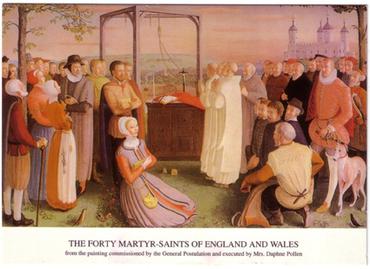
Of the feasts of the whole of England and Wales, a full 'missa propria' was composed for 'BB Joannis Fischer et Thomae Morus': that is, Bishop John Fisher and Thomas More, when they were beatified in 1886; the feast was originally celebrated on 4th May. This Mass, 'Deus venerunt gentes', stayed on 4th May when SS Fisher & More were canonised and moved to July 9th (getting a new Mass formulary), and 4th May became the feast of the Blessed Martyrs of England and Wales. I have found it in the English Benedictine supplement included in a 1908 Schwann Graduale and a later Solesmes Graduale, both of which I have been able to scan. It is a 3rd Class feast.

Here is the Introit being sung by the Schola Abelis of Oxford; there are more videos of the propers of this Mass here.


As a service to readers I have uploaded a booklet of these propers to the Latin Mass Society website, and you can download them here:

http://www.lms.org.uk/resources/gregorian-chant/chant_proper_booklets/proper_chants_for_4th_may

Bishop Fisher and Thomas More were canonised in 1935, and I have found their new Mass pasted into the back of an old Liber Usualis I own, with an Imprimatur dated 1936. Even more conveniently, it is to be found in the Graduale Romanum's appendix 'Masses for Certain Places', including the Gradual scanned by the Church Music Association of America. Here is this Mass:


http://www.lms.org.uk/resources/gregorian-chant/chant_proper_booklets/chants_for_ss_fisher_and_more

All sorts of things can be found pasted into the back of old Libers, or loose within its pages: St Joan of Arc, St Joseph the Workman, and other things obviously added to the calendar since the date of the printing of that particular Liber. Clearly these little booklets were made available when the Mass texts and melodies were published. What I have never seen, however, in an official supplement or pasted in somewhere, are the proper chants for diocesan feasts, in cases where these are not simply borrowed from other feasts and commons. I shall be posting about some of these later.

19 December 2011

Second Biennial Meeting of the Gregorian Chant Network

Nearly two years ago, on January 30th 2010, the GCN was launched at a meeting at the London Oratory, attended by representatives of about two dozen chant scholas and a number of people involved in singing or teaching the chant. We agreed at that time to have such a meeting every two years.

The launch meeting was widely reported and was addressed by Colin Mawby, the distinguished composer and former Director of Music at Westminster Cathedral.

The next meeting is now well in preparation, and will take place on Saturday, 18th February 2012, at the London Oratory (the St Wilfrid Hall and the Little Oratory). It will be addressed by James MacMillan, another Catholic composer deeply concerned about, and practically involved in, chant. The Apostolic Nuncio, Archbishop Mennini, will join us and lead Vespers in the Little Oratory.

The meeting is an internal meeting of the GCN and as such it is invitation only. The directors of all our affiliated choirs and scholas are automatically invited, as are representatives from our 'supporter' organisations: the Latin Mass Society, the Association for Latin Liturgy, the Schola Gregoriana, Una Voce Scotland, and the St Catherine's Trust. Others involved with the chant have been invited as before. Anyone with a Catholic choir or schola can naturally get an invitation by affiliating.

For those who have received invitations, don't forget to reply!